

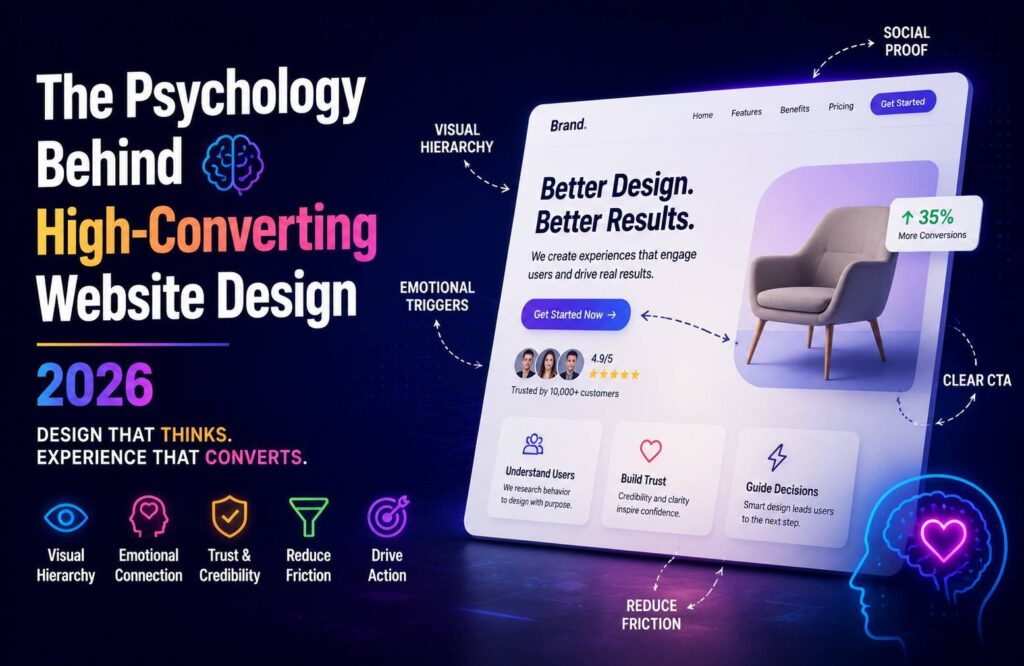
High-Converting Website Design is not only about attractive colors, modern layouts, or impressive animations. It is also about understanding how visitors think, feel, and behave when they interact with a website. Every design element can influence whether users continue browsing, trust a business, sign up for a service, or make a purchase.
By applying principles of psychology to web design, businesses can create websites that feel intuitive, trustworthy, and persuasive while providing a better experience for visitors.
Why Psychology Matters in Website Design
People make many decisions within seconds of arriving on a website. They quickly judge whether a site looks trustworthy, whether the information is relevant, and whether they can easily find what they need.
A psychologically informed design reduces confusion and makes important decisions easier. Instead of forcing visitors to think about where to click or what to do next, the website naturally guides them toward the desired action.
This is where Website Psychology becomes important. Understanding user behavior allows designers to create experiences that match visitors’ expectations and motivations.
Psychology Behind High-Converting Website Design
1. First Impressions Influence Trust
First impressions matter online. When visitors land on a website, they immediately evaluate its appearance, organization, and credibility.
A professional design can create a positive first impression, while a cluttered or outdated website may cause visitors to leave before exploring the content.
Businesses should use consistent branding, readable typography, high-quality images, and a clean layout. Trust signals such as testimonials, reviews, security information, client logos, and clear contact details can also reduce uncertainty.
The goal is to make visitors feel that they are dealing with a legitimate and reliable business.
2. Visual Hierarchy Guides Attention
Visitors rarely read every word on a webpage. Instead, they scan the page and focus on elements that appear most important.
Visual Hierarchy helps designers control this attention. Size, contrast, spacing, typography, and positioning can indicate which information users should notice first.
For example, a large headline can communicate the primary message, while a contrasting call-to-action button can encourage users to take the next step.
A strong visual hierarchy creates a natural flow:
Headline → Value Proposition → Supporting Information → Call to Action
When important elements are easy to identify, visitors can understand the page faster and make decisions with less effort.
3. Colors Can Influence Emotions
Color is more than a decorative element. Different colors can create different emotional associations.
Blue is often associated with trust and professionalism, while green may suggest growth, health, or nature. Red can communicate urgency or energy, whereas neutral colors can create a clean and sophisticated appearance.
However, color psychology should not be applied mechanically. Cultural expectations, industry standards, branding, and audience preferences also matter.
The most important principle is consistency. A website should use a controlled color palette and reserve strong accent colors for important elements such as buttons, links, or promotional messages.
4. Simplicity Reduces Cognitive Load
Too many choices can overwhelm visitors. When a webpage contains excessive text, images, menus, pop-ups, and buttons, users may struggle to determine what they should do next.
A simple design reduces cognitive load by presenting information in a clear and organized way.
Designers can improve simplicity by using white space, short paragraphs, descriptive headings, limited navigation options, and clear calls to action.
A visitor should not have to work hard to understand the website. The easier the experience feels, the more likely users are to continue exploring.
5. Social Proof Builds Confidence
People often look at the experiences of others before making a decision. This psychological principle makes social proof particularly valuable for websites.
Customer reviews, testimonials, ratings, case studies, client logos, and user statistics can demonstrate that other people have already trusted the business.
For example, a service page could include customer testimonials directly below the main offer. Seeing positive experiences from previous customers can reduce hesitation and strengthen credibility.
Social proof is especially useful when visitors are unfamiliar with a company or considering an expensive purchase.
6. Effective Calls to Action Encourage Action
A website may have excellent content, but visitors still need clear direction. This is why calls to action are essential for Conversion Rate Optimization.
Instead of using vague buttons such as “Click Here,” businesses can use action-oriented phrases such as “Get a Free Quote,” “Start Your Project,” “Book a Consultation,” or “Shop Now.”
The placement of the CTA also matters. It should be visible after visitors understand the value of the offer.
Using one primary action on important landing pages can prevent users from becoming distracted by competing choices.
7. Personalization Can Improve Engagement
Visitors respond better when websites feel relevant to their needs. Personalized content can help businesses create a stronger connection with different audiences.
For example, an e-commerce website might recommend products based on browsing behavior, while a service company could create separate landing pages for different customer groups.
Personalization should feel helpful rather than intrusive. Businesses should focus on providing relevant information that makes the user’s journey easier.
8. Mobile Experience Affects User Behavior
A large percentage of website visitors use smartphones. A website that works well on desktop but performs poorly on mobile can lose potential customers.
Responsive layouts, readable fonts, fast-loading pages, touch-friendly buttons, and simple navigation are essential for a positive mobile experience.
Good User Experience (UX) means visitors can complete important tasks regardless of the device they use.
Conclusion
The psychology behind website design shows that successful websites are built around people, not just visual trends. Trust, color, hierarchy, simplicity, social proof, personalization, and clear calls to action can all influence visitor behavior.
By combining attractive design with psychological principles, businesses can create websites that communicate value quickly, reduce friction, and encourage meaningful actions. Ultimately, effective website design should make visitors feel confident, understood, and guided throughout their journey.