

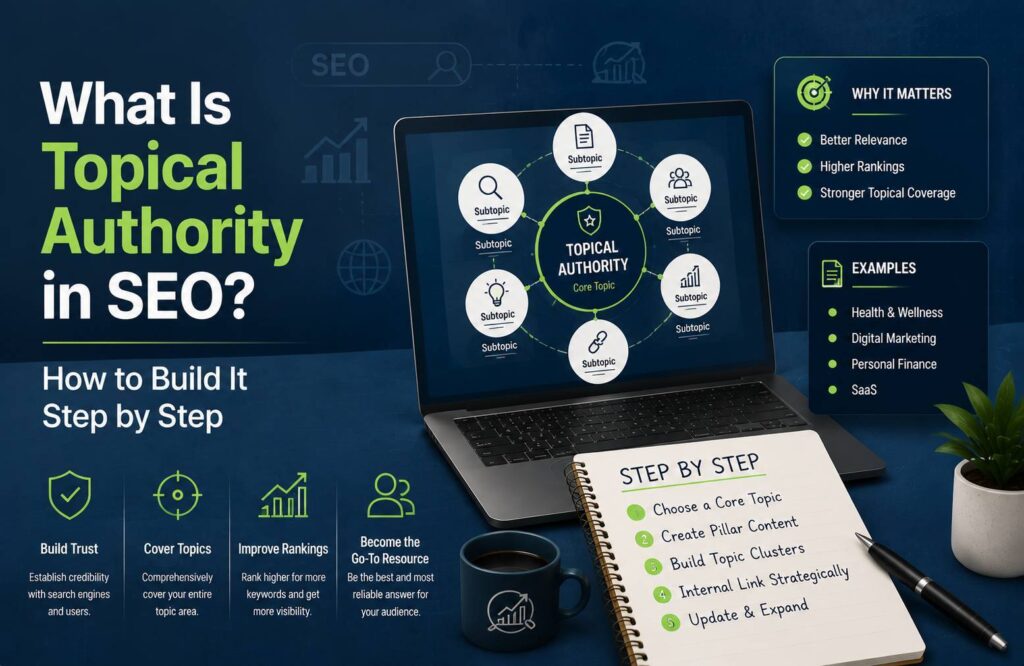
What Is Topical Authority in SEO?
Topical authority in SEO refers to how comprehensively a website covers a particular subject and demonstrates useful knowledge about it. Instead of publishing random articles around individual keywords, a website builds a connected collection of high-quality content that answers different questions within the same topic.
For example, a website focused on WordPress SEO could cover keyword research, technical SEO, internal linking, schema markup, Core Web Vitals, image optimization, and content optimization.
The goal is not simply to publish more articles. The goal is to provide complete and useful coverage of a subject so both users and search engines can better understand the website’s expertise.
Google emphasizes helpful, reliable, people-first content rather than content created primarily to manipulate search rankings. Therefore, topical authority should be built through useful content and a logical website structure.
Why Is Topical Authority Important?
Search engines need to understand the context and relevance of web pages. When a website consistently publishes useful content around a focused subject, its pages can form a stronger topical relationship.
Building topical authority can help you:
- Cover more relevant search queries.
- Improve internal linking.
- Build stronger topical relevance.
- Help search engines understand your site’s subject.
- Provide better information to visitors.
- Discover new content opportunities.
- Create a more organized SEO strategy.
However, topical authority does not guarantee rankings. Search engines consider many factors, including relevance, content quality, search intent, technical SEO, links, and user experience.
The purpose should therefore be to build genuine expertise rather than trying to create an artificial ranking signal.
Topical Authority vs. Domain Authority
Topical authority and domain authority are different concepts.
Domain Authority is a third-party SEO metric used by tools to estimate the strength of a website, often based partly on its backlink profile.
It is not a Google ranking score.
Topical authority focuses on how thoroughly and effectively a website covers a specific subject.
For example, a website may have fewer backlinks than a large competitor but still provide excellent coverage of a narrow topic. By creating comprehensive content and connecting related pages, that website can establish strong topical relevance within its niche.
This is particularly useful for small websites because they can focus their resources on a specific subject instead of trying to compete across an entire industry.
How to Build Topical Authority Step by Step
1. Choose a Specific Core Topic
Start with a clear topic that matches your website, audience, expertise, and business goals.
For example, a digital marketing website might choose SEO as its core subject. A WordPress agency might focus on WordPress SEO and development.
Avoid choosing an unnecessarily broad topic if you cannot provide meaningful coverage.
A focused subject makes it easier to develop a consistent content strategy.
2. Identify Important Subtopics
Break your main topic into smaller, closely related areas.
For example, under SEO, you might have:
- Keyword research
- On-page SEO
- Technical SEO
- Local SEO
- Content SEO
- Internal linking
- Schema markup
- Search intent
- Semantic SEO
These subtopics become the foundation of your content plan.
3. Create a Topical Map
A topical map organizes the subjects your website should cover.
For example:
SEO
→ Keyword Research
→ On-Page SEO
→ Technical SEO
→ Content SEO
→ Local SEO
→ Link Building
Each category can contain more specific articles.
Under keyword research, you could publish articles about long-tail keywords, keyword mapping, search intent, keyword difficulty, and competitor keyword research.
A topical map helps prevent random content creation and reveals gaps in your existing coverage.
4. Create Pillar and Supporting Content
A pillar page provides broad coverage of a major topic, while supporting articles explain specific subtopics in greater detail.
For example:
Pillar: Complete SEO Guide
Supporting articles:
- What Is Keyword Research?
- What Is Search Intent?
- How to Write SEO-Friendly Content
- What Is Technical SEO?
- How Does Internal Linking Work?
- What Is Semantic SEO?
This structure is commonly called a topic cluster or content cluster.
The pillar page gives readers an overview, while supporting pages answer more specific questions.
5. Build Relevant Internal Links
Internal linking is an important part of topical SEO.
Connect related pages using natural, descriptive anchor text. For example, an article about keyword mapping could link to your guide about keyword research.
Similarly, supporting articles can link back to the main pillar page when relevant.
Good internal links help visitors discover related information and make your website easier to navigate. They can also help search engines discover pages and understand relationships between content.
Avoid adding links simply to increase the number of internal links. Every link should provide value to the reader.
6. Create Content That Demonstrates Expertise
Publishing many articles does not automatically create topical authority.
Your content should provide something useful that readers cannot easily get from a generic article.
Consider adding:
- Practical examples
- Original research
- Case studies
- Screenshots
- Expert insights
- Step-by-step processes
- Data and statistics
- Personal experience where appropriate
Strong content should answer the user’s question clearly instead of stretching a simple topic into unnecessary sections.
7. Cover Different Search Intents
A strong topical strategy should address different types of search intent.
For example, someone searching “what is internal linking” may want educational information.
Someone searching “best internal linking tools” may be comparing solutions.
Someone searching “hire SEO consultant” has a commercial or transactional intent.
Covering relevant informational, commercial, and transactional topics can create a more complete content ecosystem.
8. Update and Improve Existing Content
Topical authority is an ongoing process.
Regularly review your existing articles to identify:
- Outdated information
- Missing subtopics
- Weak internal links
- Duplicate content
- Broken links
- Poor search-intent alignment
- Opportunities for better examples
Don’t update articles merely to change their publication dates. Make meaningful improvements when information, examples, or recommendations need to change.
Common Topical Authority Mistakes
One common mistake is publishing too much low-quality content. More pages do not automatically mean more authority.
Another mistake is targeting every keyword variation with a separate article. If several keywords have the same search intent, they may be better addressed on one comprehensive page.
Ignoring internal links is another problem. Even valuable articles can become isolated if they are not connected to relevant pages.
Finally, avoid covering unrelated subjects just because they have search volume. Your content should support the main purpose of your website.
How Long Does It Take to Build Topical Authority?
There is no fixed timeframe for building topical authority. Results depend on your website’s existing content, competition, topic difficulty, content quality, internal linking, technical SEO, and overall authority.
Instead of asking how many articles you need, ask:
“Have I covered the important questions my audience has about this topic?”
That question leads to a much better content strategy.
Conclusion
Topical authority in SEO is about becoming a useful and comprehensive resource for a specific subject. It is not simply about publishing hundreds of keyword-focused articles.
Start with a focused topic, build a topical map, create pillar and supporting content, connect related pages with internal links, demonstrate genuine expertise, and continuously improve your existing resources.
When your website consistently answers important questions and provides useful connections between related topics, you create a stronger foundation for long-term organic search visibility.