

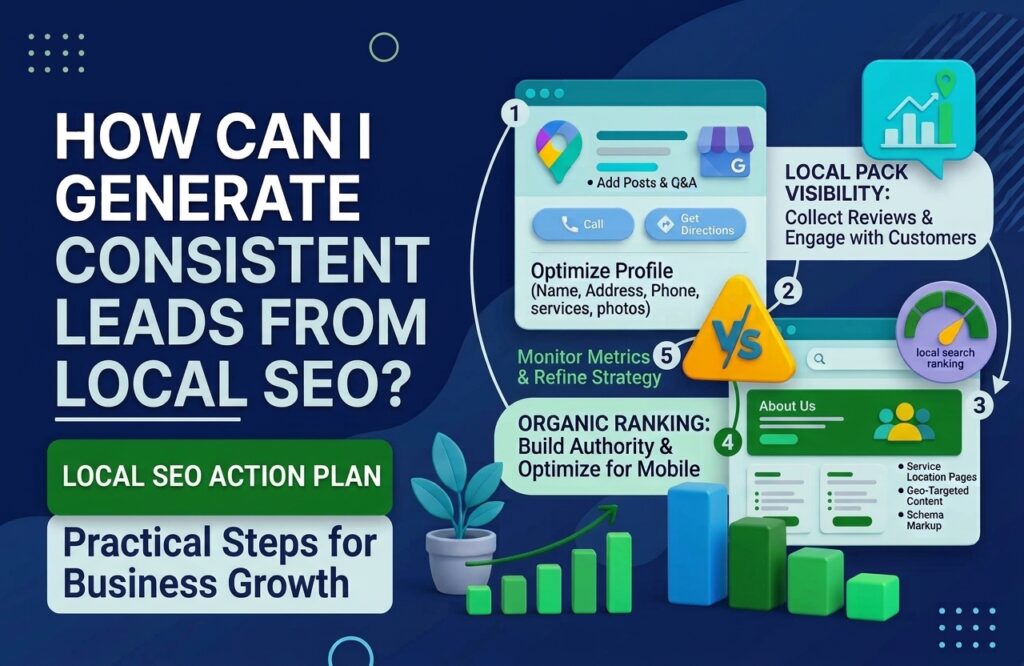
Generating consistent leads from local SEO is one of the most effective ways for service businesses to attract potential customers without depending entirely on paid advertising. When your business appears when people search for services in your area, you can generate phone calls, website inquiries, quote requests, and bookings from people who are already looking for what you offer.
However, simply creating a Google Business Profile or publishing a few blog posts is not enough. A successful local SEO strategy requires the right combination of Google Business Profile optimization, local keywords, service pages, reviews, citations, backlinks, and useful content.
1. Optimize Your Google Business Profile
Your Google Business Profile is one of the most important assets for local search visibility.
Make sure your profile contains accurate and complete information, including:
- Business name
- Address or service area
- Phone number
- Website
- Business hours
- Primary and secondary categories
- Services
- Business description
- Photos and videos
Choose the most relevant primary category for your business. Add your important services and keep your information consistent with your website.
A well-optimized profile can help your business appear in Google Maps and local search results when potential customers search for your services.
2. Target Local Keywords
Keyword research is an important part of generating local SEO leads.
Instead of targeting only broad keywords such as “plumber” or “roofing company,” focus on keywords that show local and commercial intent.
For example:
- plumber in [city]
- emergency plumber near me
- residential plumber [city]
- roof repair [city]
- local electrician [city]
- bathroom remodeling contractor [city]
You should also identify long-tail keywords related to specific services. These keywords can have less competition and often attract people who are closer to making a purchase decision.
3. Create Dedicated Service Pages
Your website should have dedicated pages for the main services you provide.
For example, a roofing company might create separate pages for:
- Roof repair
- Roof replacement
- Emergency roofing
- Commercial roofing
- Roof inspection
Each page should clearly explain the service, locations served, benefits, process, pricing information when appropriate, frequently asked questions, and a strong call to action.
Avoid creating nearly identical pages just to target different cities. Each location page should provide genuinely useful, location-specific information.
4. Build Location-Relevant Content
Blog content can help your website capture searches that your main service pages may not target.
Create useful content around questions your potential customers ask before hiring a service provider.
Examples include:
- How much does roof repair cost?
- How often should you service an HVAC system?
- How long does a bathroom remodel take?
- What should I do if my water heater stops working?
- How do I choose a local electrician?
This type of content can attract people earlier in the buying journey and introduce them to your business.
5. Get More Genuine Customer Reviews
Reviews can play an important role in local SEO and customer decision-making.
Ask satisfied customers to leave honest reviews about their experience. Make the process easy by providing a direct review link.
You can also encourage customers to mention the service they received naturally in their review. However, don’t write reviews for customers, manipulate reviews, or pressure customers into using specific keywords.
Respond professionally to both positive and negative reviews. This demonstrates that your business values customer feedback.
6. Keep Your Business Information Consistent
Your business name, address, phone number, and other important information should be accurate across your website, Google Business Profile, directories, and other relevant platforms.
Inconsistent information can create confusion for customers and search engines.
Check important business directories and update outdated information whenever your business changes its phone number, address, website, or operating hours.
7. Build Local Backlinks
Local backlinks can strengthen your website’s authority and relevance.
Look for legitimate opportunities such as:
- Local business directories
- Chamber of commerce websites
- Local associations
- Community organizations
- Local sponsorships
- Industry organizations
- Local news websites
- Relevant business partnerships
Focus on quality and relevance rather than buying large numbers of low-quality links.
A few relevant local links can be more valuable than hundreds of unrelated links.
8. Make Your Website Easy to Convert
Getting traffic is only part of the process. Your website must turn visitors into leads.
Make your contact information easy to find and include clear calls to action throughout your website.
Depending on your business, useful CTAs may include:
Call Now, Request a Quote, Book an Appointment, Get a Free Estimate, or Contact Us.
For mobile users, consider making your phone number clickable.
You should also make sure your website loads quickly, works properly on mobile devices, and provides a simple path from the landing page to contacting your business.
9. Track Your Local SEO Leads
You can’t improve what you don’t measure.
Track important metrics such as:
- Organic traffic
- Google Business Profile interactions
- Phone calls
- Form submissions
- Quote requests
- Appointment bookings
- Keyword rankings
- Website conversions
- Leads by location
Google Search Console and Google Analytics can help you understand how people discover and interact with your website.
The goal isn’t simply to increase traffic. The goal is to generate qualified leads that can become paying customers.
10. Continue Improving Your Local SEO Strategy
Local SEO is not a one-time task. Competitors can improve their websites, publish new content, earn reviews, and build local authority.
That’s why consistency matters.
Regularly review your Google Business Profile, update important website pages, publish useful content, earn genuine customer reviews, monitor rankings, and identify new keyword opportunities.
You should also analyze competitors that consistently appear in local search results. Look at the services they promote, the topics they cover, their reviews, and the local websites linking to them.
Don’t copy competitors. Instead, identify opportunities where your business can provide better and more useful information.
Conclusion
Generating consistent leads from local SEO requires more than simply ranking for one keyword. You need a complete system that connects your Google Business Profile, website, service pages, local keywords, reviews, backlinks, content, and conversion strategy.
For service businesses, the biggest opportunity is to target people who are actively searching for a solution in your service area.
Start by optimizing your Google Business Profile, targeting high-intent local keywords, creating strong service pages, collecting genuine reviews, building relevant local authority, and tracking actual leads.
With consistent optimization and measurement, local SEO can become a sustainable source of qualified leads instead of relying entirely on paid advertising.