
Get Your Local Business Mentioned in AI Search
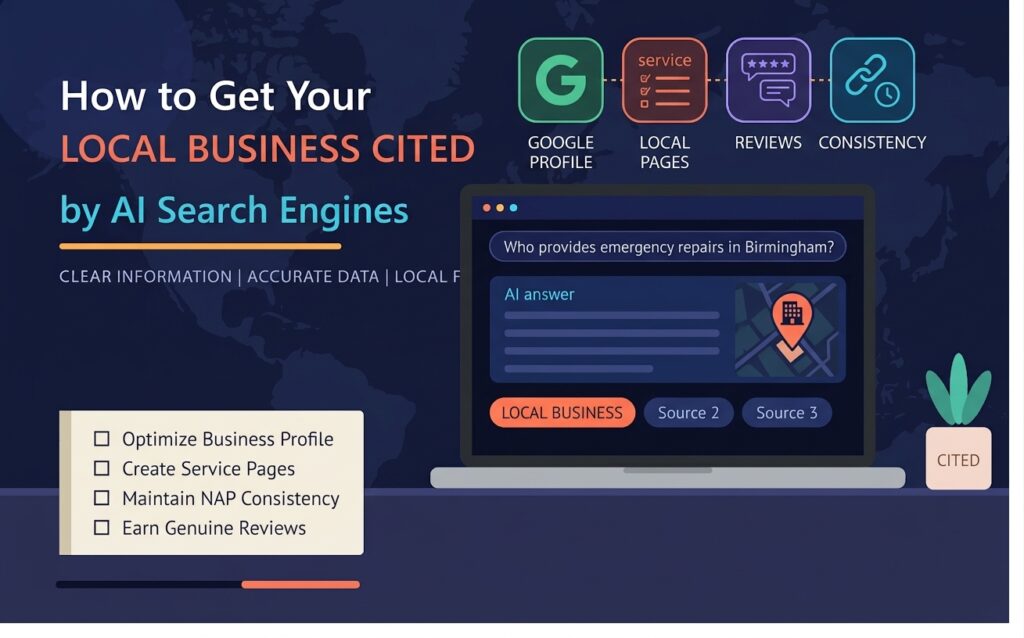
Improving local business AI visibility helps your business become easier to discover when potential customers use ChatGPT, Google AI Overviews, Gemini, and other AI-powered search tools to find local services. Instead of relying only on traditional search results, businesses can strengthen their online presence through accurate business information, helpful website content, genuine customer reviews, and trusted online mentions. Although no strategy guarantees an AI recommendation, the right SEO practices can improve your chances of being discovered.
What Is Local Business AI Visibility?
Local business AI visibility refers to how easily AI-powered search experiences can discover, understand, and potentially mention a local business when answering customer questions.
For example, someone might ask an AI assistant, “Which plumber provides emergency repairs in Birmingham?” The response may mention businesses based on available information about their services, locations, reputation, and website content.
AI search experiences do not all work identically. Google AI Overviews use Google’s search systems, while other assistants may retrieve information from different search indexes and online sources. Therefore, businesses should build a consistent, trustworthy digital presence rather than rely on one platform.
1. Optimize Your Google Business Profile
Your Google Business Profile helps Google understand your business, its location, services, and operating hours. Keeping this information accurate supports local search visibility and makes it easier for potential customers to evaluate your business.
Start by completing these essential details:
- Business name that accurately represents your real-world business.
- Correct primary and relevant secondary categories.
- Accurate address or service area, where applicable.
- Current opening hours, phone number, and website.
- Detailed service descriptions and relevant business attributes.
- High-quality photos that genuinely represent your business.
Update your profile whenever important business information changes. Respond professionally to customer reviews and keep your service information current.
These actions support traditional local SEO and can help establish a clearer picture of your business across Google’s search experiences. However, a complete profile does not guarantee that an AI response will mention your business.
2. Create Helpful Local Service Pages
Your website should clearly explain what your business does, where you operate, and how customers can benefit from your services.
For example, a plumbing company serving Birmingham could create a dedicated page explaining its emergency plumbing services, service coverage, common plumbing problems, and booking process.
A useful local landing page should include:
- A clear heading describing the service and location.
- An explanation of the problems you solve.
- Your actual service areas and availability.
- Relevant pricing information, if appropriate.
- Genuine examples of completed projects or customer experiences.
- Clear contact details and a booking or enquiry option.
Avoid publishing multiple nearly identical pages that change only the city name. Instead, create useful location-specific content that reflects your actual services and provides meaningful information to customers.
Clear, informative pages help search engines interpret your expertise and give customers a reason to trust your business.
3. Make Your Business Information Consistent
Inconsistent business information can make it harder for customers and search systems to identify the correct business.
Check your business name, address, phone number, website, opening hours, and service categories across your website and important third-party listings.
Prioritize reputable directories and platforms relevant to your industry and location. Depending on your market, these may include Bing Places, established local directories, professional associations, and industry-specific listing websites.
Correct outdated listings and remove duplicate entries where possible.
You do not need to submit your business to hundreds of directories. Focus on accurate information in sources that customers genuinely use and that are relevant to your business.
Consistency is especially important when your business has multiple branches or operates under a name that differs from its legal company name.
4. Earn Genuine Customer Reviews
Customer reviews provide useful evidence of real customer experiences. They can also help prospective customers compare local businesses.
Encourage satisfied customers to leave honest reviews on relevant platforms. Make the process simple by sharing your review link after completing a service or purchase.
To build a stronger review profile:
- Ask customers for honest feedback without pressuring them.
- Respond to positive and negative reviews professionally.
- Address recurring complaints and improve your service.
- Follow each platform’s policies on review requests and incentives.
- Never purchase reviews or create fake customer accounts.
When customers naturally describe the service they received, their feedback can provide useful context about your business.
Remember that reviews are only one part of your online reputation. Strong service pages, accurate listings, and credible references from other sources also matter.
5. Publish Content That Answers Local Questions
People increasingly use conversational questions when searching for local services. Your website can address these questions with practical, specific answers.
For example, a local electrician could publish articles addressing questions such as:
- How much does an electrician cost in Birmingham?
- When should you replace an electrical consumer unit?
- What should you do during an electrical emergency?
- Which electrical services require a qualified professional?
Write answers based on genuine expertise, local requirements, and accurate information. Use descriptive headings, concise explanations, relevant examples, and links to related service pages.
Where appropriate, include FAQs on relevant pages, but avoid creating repetitive content solely to target every possible question.
Useful content can attract traditional organic traffic and give search systems additional information about your expertise.
6. Use Structured Data Correctly
Structured data helps search engines interpret specific information on your website. For eligible local businesses, LocalBusiness schema can describe details such as the business name, address, telephone number, opening hours, and website.
Implement structured data that accurately reflects the information visible to visitors. Select the most appropriate business subtype and include only properties that apply to your business.
For example, a restaurant should use a relevant restaurant subtype rather than choosing an unrelated business category.
Validate your implementation using Google’s Rich Results Test and Schema.org’s validator where appropriate. Check for conflicting or duplicate markup generated by SEO plugins and other website tools.
An important distinction: schema markup does not guarantee AI mentions, and Google does not require special AI-specific schema to appear in its AI search features. Use structured data as part of a broader technical SEO strategy, not as a shortcut to AI recommendations.
7. Build Credible Local Mentions and Links
Your business becomes easier to research when reputable websites publish accurate information about it.
Look for legitimate opportunities to earn mentions through local news coverage, community partnerships, professional associations, industry publications, and relevant business directories.
For example, a local home improvement company might contribute expert advice to a regional publication or sponsor a genuine community event that receives independent coverage.
Prioritize relevance and credibility over the number of mentions. Avoid mass-produced guest posts, paid links intended to manipulate rankings, and fabricated recommendations.
Google’s guidance on generative AI search emphasizes helpful content and trustworthy information rather than artificial mentions created to influence AI responses.
8. Measure Your AI Search Visibility
You cannot improve what you never evaluate. Create a simple monitoring process to understand whether your business appears in relevant AI-powered search experiences.
Start with a list of realistic customer questions, such as “best [service] in [city]” or “who provides [specific service] near [location]?”
Test these questions periodically in relevant AI tools. Record whether your business is mentioned, which competitors appear, whether your website is cited, and which sources support the answers.
Also monitor traditional SEO performance using Google Search Console and Google Analytics. Track relevant local search queries, organic traffic, enquiries, phone calls, and conversions.
AI responses can vary by location, wording, time, and platform. A single test does not establish your overall visibility, so repeat checks consistently and look for patterns.
Conclusion
Improving local business AI visibility starts with strong local SEO fundamentals. Maintain an accurate Google Business Profile, build useful service pages, keep business listings consistent, earn genuine customer reviews, publish helpful local content, and develop a credible online reputation.
Use structured data where appropriate and measure your results over time. There is no guaranteed formula for being mentioned by ChatGPT or appearing in Google AI Overviews, but a clear, trustworthy, customer-focused online presence gives your business a stronger foundation for discovery across traditional and AI-powered search experiences.
Explore More..