
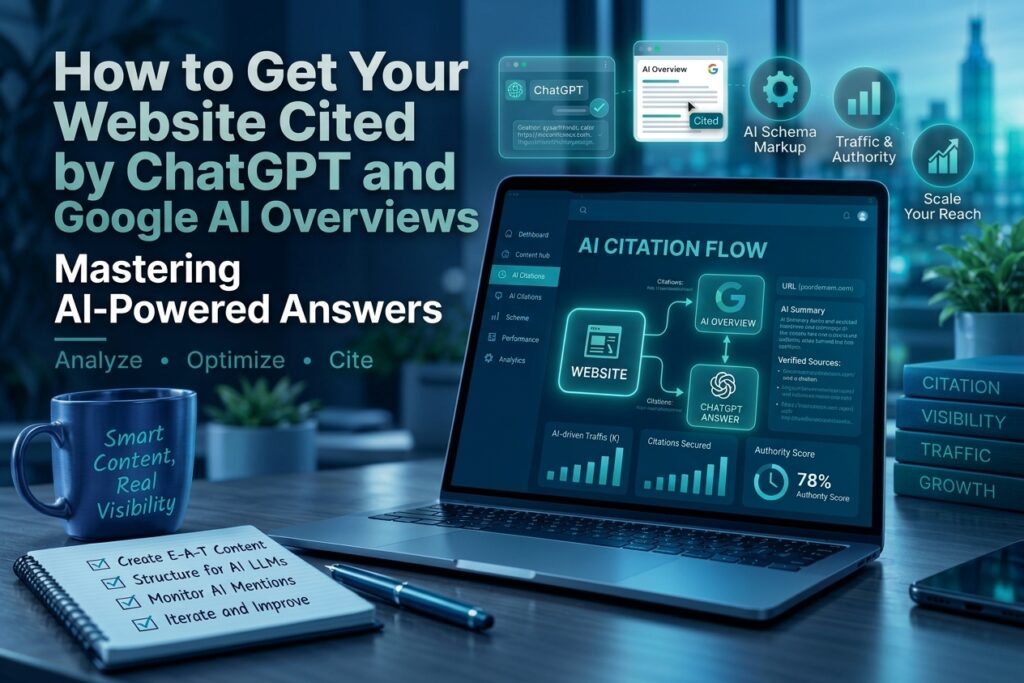
Get Your Website Cited by ChatGPT and Google AI Overviews
Learning how to get your website cited by ChatGPT and Google AI Overviews can help your business reach people who use AI tools to find information, compare services, and make decisions. Traditional SEO remains important, but AI search visibility also depends on how clearly your content answers questions, demonstrates expertise, and supports its claims with reliable information.
Although no technique guarantees an AI citation, you can improve your website’s chances by combining helpful content, technical SEO, topical authority, and a strong user experience.
1. Understand How AI Search Citations Work
ChatGPT and Google AI Overviews help users understand topics by generating answers from information available to them. Depending on the query and product experience, their responses may include links to supporting websites.
A citation can introduce your business to people who might not discover your pages through traditional search results. However, these systems do not always cite the same sources, and not every response includes website links.
Your goal should be to create content that is accurate, relevant, easy to understand, and useful enough to serve as a trustworthy source.
This is where answer engine optimization (AEO) and generative engine optimization (GEO) complement traditional SEO.
2. Create Content That Directly Answers Questions
AI search systems need useful information to construct relevant answers. Organize your content around the questions your target audience actually asks.
For example, a WordPress website owner might search for:
- How do I improve my website’s visibility in AI search?
- Why is my website not appearing in Google AI Overviews?
- What makes content trustworthy for AI search tools?
- How can I optimize a website for conversational search queries?
Use these questions to build relevant headings and answer each one with clear, specific explanations.
Place a concise answer near the beginning of each section, followed by supporting details, examples, or practical steps. This structure improves readability and makes important information easier to identify.
Avoid publishing generic articles that repeat information already available everywhere. Original explanations, practical examples, and relevant insights can make your content more valuable.
3. Build Topical Authority With Related Content
Publishing one article about AI search optimization is rarely enough to establish comprehensive expertise. Develop a collection of related articles that cover the subject from different angles.
For example, you could publish content about:
- Answer engine optimization for WordPress websites
- Generative engine optimization best practices
- Technical SEO for AI search visibility
- Structured data and search engine understanding
- Writing helpful content for conversational queries
Connect these articles through relevant internal links. A reader exploring AI search optimization should be able to discover your related guides without returning to the search results.
This approach helps establish topical authority and creates a more useful website structure. Each article should address a distinct search intent rather than repeating the same information with a different title.
4. Strengthen Content Accuracy and Trustworthiness
Trustworthy information is essential when creating content that you want search systems and users to rely on.
Demonstrate experience and expertise through accurate explanations, real examples, transparent authorship, and reliable supporting evidence. Google’s guidance on experience, expertise, authoritativeness, and trustworthiness (E-E-A-T) provides a useful framework for evaluating content quality.
When discussing statistics, technical recommendations, or industry developments, cite credible sources where appropriate. Verify facts before publishing and update outdated information when necessary.
Avoid unsupported claims such as guaranteed rankings or guaranteed AI citations. Search systems change, and no SEO professional can promise that a particular page will always appear in AI-generated answers.
For service businesses, clear information about services, business identity, qualifications, and relevant experience can also help visitors evaluate credibility.
5. Use Structured Data and Technical SEO
Structured data helps search engines interpret specific information about a webpage. Depending on the page, relevant schema types may include Article, Organization, Person, BreadcrumbList, or other supported types.
Implement structured data that accurately reflects the visible content on your website. Validate the markup using Google’s Rich Results Test and Schema Markup Validator where appropriate.
However, structured data does not guarantee AI citations. It supports machine-readable understanding and can help search engines interpret eligible content.
Also review your website’s technical foundations:
- Ensure important pages are accessible to search engine crawlers.
- Use appropriate indexability settings and canonical URLs.
- Submit an accurate XML sitemap.
- Fix broken internal links and unnecessary redirect chains.
- Improve mobile usability and page loading performance.
- Check whether relevant AI search crawlers are permitted under your website’s access rules and applicable policies.
Do not block search crawlers indiscriminately. Review the documentation for the particular search or AI service you want to support.
6. Optimize Pages for Conversational Search
People often ask AI tools complete questions instead of entering short keywords. Your content should address these natural-language queries while maintaining a clear primary topic.
For example, instead of focusing only on the phrase “AI SEO,” create a section answering “How can a small business improve its visibility in AI search results?”
Use descriptive headings, short paragraphs, numbered instructions, and comparison tables when they genuinely help readers. Define technical terms before using them extensively.
Include relevant related terms naturally, but avoid keyword stuffing. Adding every possible variation of a search phrase will not automatically improve AI search visibility.
The objective is to provide a complete answer that satisfies the user’s intent rather than simply increasing keyword frequency.
7. Earn Relevant Mentions and Build Brand Authority
Your website is only one part of your online presence. Relevant mentions of your business, author, or expertise across credible websites can help people discover and evaluate your brand.
Consider publishing original research, contributing expert commentary, sharing useful resources, and building relationships with relevant industry websites.
For local businesses, maintain consistent business information across appropriate directories and keep your Google Business Profile accurate. These activities support local discoverability, although they do not guarantee that an AI system will cite your website.
Prioritize genuine editorial value over mass directory submissions or purchased links intended to manipulate rankings. Quality, relevance, and accuracy matter more than simply accumulating mentions.
8. Monitor AI Search Visibility and Improve Your Content
AI-generated answers can vary by query, location, time, and product. Track performance rather than assuming that publishing an optimized article will immediately generate citations.
Use Google Search Console to monitor impressions, clicks, indexing status, and the performance of relevant pages. Review available analytics data for referral traffic from AI platforms, recognizing that attribution may be incomplete.
You can also test a consistent set of relevant questions in ChatGPT and Google AI Overviews when available. Record whether your brand appears, which pages are cited, and which competing sources are referenced.
Use those observations to identify missing information, strengthen weak sections, and improve supporting evidence. Treat manual checks as directional observations, not a complete measurement of all AI-generated responses.
Conclusion
Getting your website cited by ChatGPT and Google AI Overviews requires a long-term approach to useful content, technical SEO, topical authority, and credibility. There is no guaranteed shortcut, and traditional search optimization still matters.
Start by improving your most valuable pages, answering specific customer questions, validating structured data, and connecting related articles through relevant internal links. Then monitor your results and refine your strategy based on evidence.
By consistently publishing accurate, helpful information, you can build a stronger foundation for organic search performance and potential visibility across AI-powered search experiences.
Explore More..