

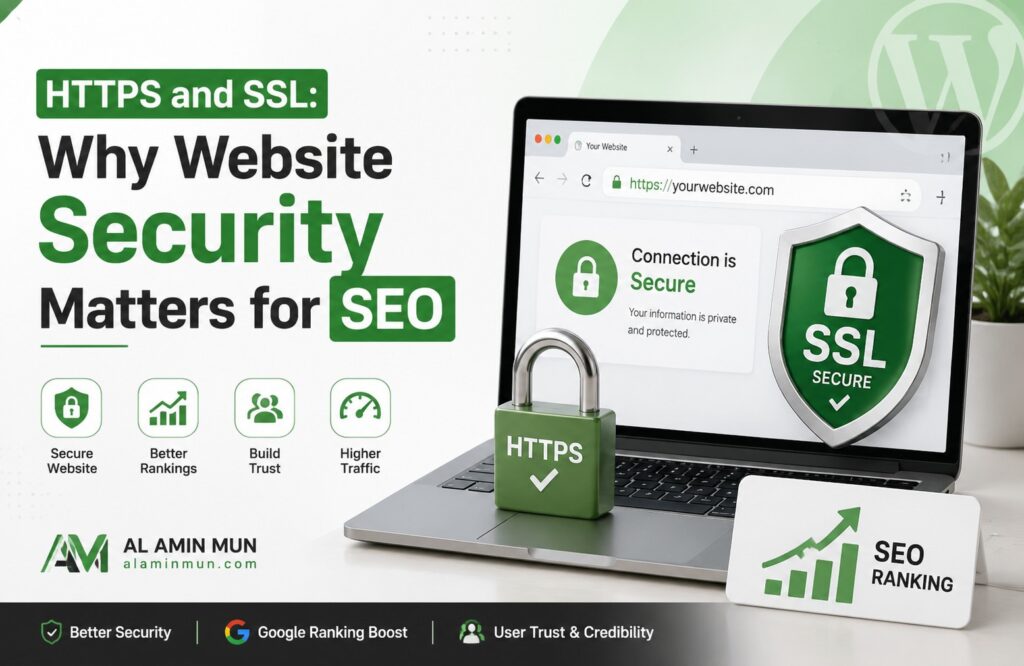
Website security has become one of the most important aspects of modern SEO. Whether you run a personal blog, an eCommerce store, or a business website, protecting your visitors’ data should be a top priority. One of the easiest ways to improve website security is by enabling HTTPS snd SSL for SEO.
Google has confirmed that HTTPS is a ranking signal, and users are more likely to trust websites that display the secure padlock icon in their browser. While HTTPS alone won’t guarantee top rankings, it contributes to a safer browsing experience and supports your overall SEO strategy.
What Are HTTPS and SSL?
HTTPS (HyperText Transfer Protocol Secure) is the secure version of HTTP, the protocol used to transfer data between a user’s browser and your website.
An SSL (Secure Sockets Layer) certificate, now commonly implemented using TLS (Transport Layer Security), encrypts the data exchanged between the browser and the web server. This encryption helps protect sensitive information such as passwords, payment details, and personal data from cybercriminals.
When a website has a valid SSL certificate, its URL begins with https:// instead of http://.
HTTPS and SSL for SEO
1. Google Uses HTTPS as a Ranking Signal
Google announced HTTPS as a lightweight ranking factor to encourage website owners to improve security. Although content quality and backlinks remain more influential, a secure website can provide a competitive advantage.
2. Builds User Trust
Visitors are more likely to stay on websites that appear secure. Most browsers display a padlock icon next to HTTPS websites, while
unsecured HTTP sites may show warnings such as “Not Secure”.
Trust can improve user engagement, reduce bounce rates, and increase conversions.
3. Protects User Data
HTTPS encrypts all data transmitted between users and your website, helping prevent hackers from intercepting sensitive information.
This is especially important for:
- Online stores
- Membership websites
- Contact forms
- Login pages
- Online payment systems
SEO Benefits of HTTPS
Using HTTPS offers several SEO advantages:
- Better user trust and credibility
- Improved data security
- Potential ranking boost
- More accurate analytics data
- Increased conversion rates
- Protection against data tampering
These benefits make HTTPS a valuable part of any technical SEO strategy.
How to Migrate from HTTP to HTTPS
If your website still uses HTTP, follow these steps:
- Purchase or install an SSL certificate from your hosting provider.
- Enable HTTPS across your entire website.
- Set up 301 redirects from HTTP pages to HTTPS versions.
- Update internal links and canonical URLs.
- Submit the updated HTTPS sitemap in Google Search Console.
- Check for mixed content issues, where secure pages load insecure resources.
A proper migration helps preserve your rankings and prevents duplicate content issues.
Common HTTPS Mistakes
Avoid these common errors:
- Forgetting to redirect HTTP pages
- Mixed content warnings
- Expired SSL certificates
- Broken internal links
- Incorrect canonical tags
- Not updating XML sitemaps
- Blocking HTTPS pages in robots.txt
Regular technical SEO audits can help identify and fix these issues.
How to Check if Your Website Is Secure
You can verify your HTTPS setup by:
- Looking for the padlock icon in your browser.
- Checking that your URL begins with https://.
- Running an SSL test using trusted online tools.
- Monitoring crawl reports in Google Search Console.
Regular checks ensure your website remains secure and accessible.
Best Practices for HTTPS and SEO
- Follow these best practices:
- Use a valid SSL/TLS certificate.
- Force HTTPS across your entire website.
- Renew SSL certificates before they expire.
- Redirect all HTTP URLs to HTTPS.
- Fix mixed content issues promptly.
- Update canonical tags, hreflang tags, and XML sitemaps after migration.
- Monitor your site with Google Search Console for security issues.
Conclusion
HTTPS and SSL for SEO are essential for both website security and SEO. They protect user data, build visitor trust, and support better search engine performance. While HTTPS is only one of many Google ranking factors, it creates a safer browsing experience and strengthens your website’s technical SEO foundation.
If your website still uses HTTP, migrating to HTTPS should be a priority. A secure website not only protects your visitors but also helps improve credibility, user experience, and long-term search visibility.