

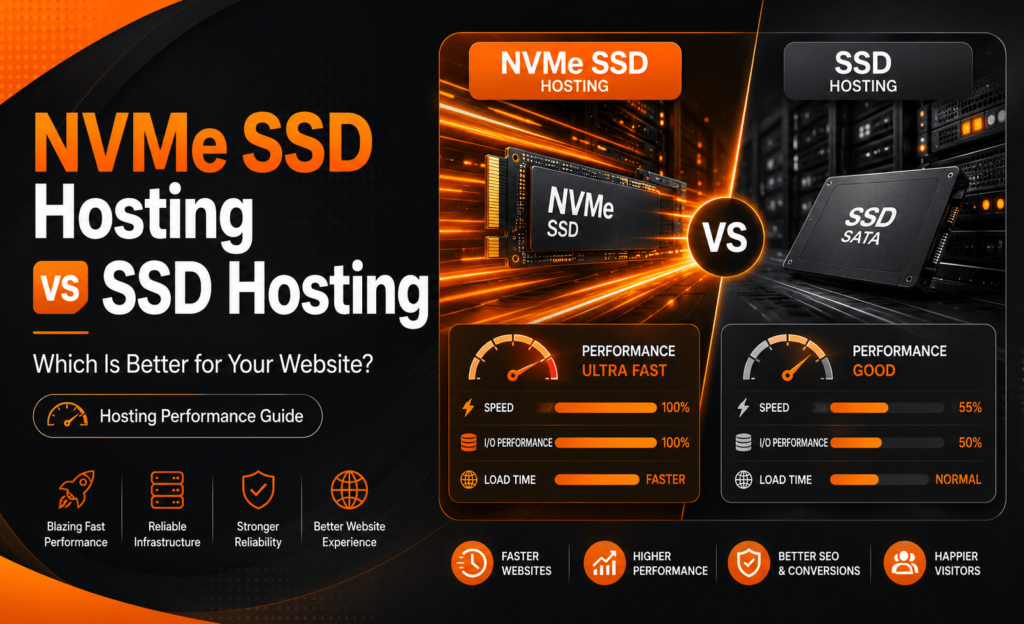
NVMe SSD Hosting vs SSD Hosting is an important comparison for anyone choosing a web hosting plan in 2026. While both storage technologies are much faster than traditional hard drives, NVMe SSD hosting offers significant improvements in speed, responsiveness, and overall server performance.
In this guide, we’ll compare NVMe SSD Hosting vs SSD Hosting to help you decide which option is best for your website.
What Is SSD Hosting?
SSD (Solid State Drive) hosting stores your website on flash memory instead of mechanical hard drives. SSDs provide faster data access, improved reliability, and shorter loading times compared to HDDs.
Benefits of SSD hosting include:
- Faster website loading
- Better reliability
- Lower power consumption
- Improved server responsiveness
- Affordable pricing
SSD hosting is still a solid choice for many personal websites and small businesses.
What Is NVMe SSD Hosting?
NVMe (Non-Volatile Memory Express) is a newer storage technology designed specifically for high-speed flash memory. Unlike traditional SATA SSDs, NVMe connects directly through the PCIe interface, allowing significantly faster data transfer speeds.
Advantages include:
- Extremely fast read and write speeds
- Lower latency
- Better multitasking performance
- Faster database queries
- Improved website responsiveness
Many premium hosting providers now use NVMe drives for their fastest hosting plans.
NVMe SSD Hosting vs SSD Hosting Speed
When comparing NVMe SSD Hosting vs SSD Hosting, speed is the biggest difference.
Traditional SATA SSDs typically reach speeds of around 500–600 MB/s. NVMe SSDs can deliver several thousand MB/s depending on the hardware and hosting infrastructure.
This means:
- Faster page loading
- Quicker WordPress dashboard
- Better WooCommerce performance
- Reduced server response time
For busy websites, the performance improvement is noticeable.
Performance Comparison
NVMe SSD Hosting
- Faster file transfers
- Excellent for high-traffic websites
- Better handling of dynamic content
- Improved database performance
- Lower latency under heavy load
SSD Hosting
- Good performance for most websites
- Reliable storage
- Lower hosting costs
- Suitable for blogs and portfolio sites
- Stable everyday performance
Which Websites Benefit Most from NVMe?
NVMe hosting is ideal for:
- WordPress websites
- WooCommerce stores
- Business websites
- Membership sites
- High-traffic blogs
- Web applications
If your website receives frequent visitors or runs many plugins, NVMe hosting provides a noticeable performance boost.
Does NVMe Improve SEO?
Indirectly, yes.
Search engines value fast-loading websites because they improve user experience. Since NVMe storage reduces loading times and server response, it can help improve Core Web Vitals and reduce bounce rates.
While storage alone won’t guarantee higher rankings, it contributes to better overall website performance.
Is NVMe Worth the Extra Cost?
For many website owners, the answer is yes.
Although NVMe hosting usually costs slightly more than standard SSD hosting, the additional speed and responsiveness often justify the investment, especially for business websites and online stores.
If you only run a small personal blog with limited traffic, standard SSD hosting may still be sufficient.
Which Should You Choose?
Choose NVMe SSD Hosting if you:
- Want maximum speed
- Run WordPress or WooCommerce
- Expect growing traffic
- Need faster database performance
- Prioritize SEO and Core Web Vitals
Choose SSD Hosting if you:
- Have a small website
- Need budget-friendly hosting
- Don’t require enterprise-level performance
- Have low to moderate traffic
Conclusion
When comparing NVMe SSD Hosting vs SSD Hosting, NVMe clearly offers better speed, lower latency, and improved performance. For modern WordPress websites, eCommerce stores, and businesses focused on user experience, NVMe hosting is the stronger long-term investment.
Standard SSD hosting remains reliable and affordable, but if your budget allows, upgrading to NVMe hosting provides faster loading times, better scalability, improved server response, enhanced Core Web Vitals, and a smoother browsing experience for your visitors as your website grows.
Learn more about WordPress performance, hosting, and SEO tips on Alaminmun Blogs to discover practical optimization strategies, hosting comparisons, and expert guides that help improve your website’s speed, rankings, and overall performance.