

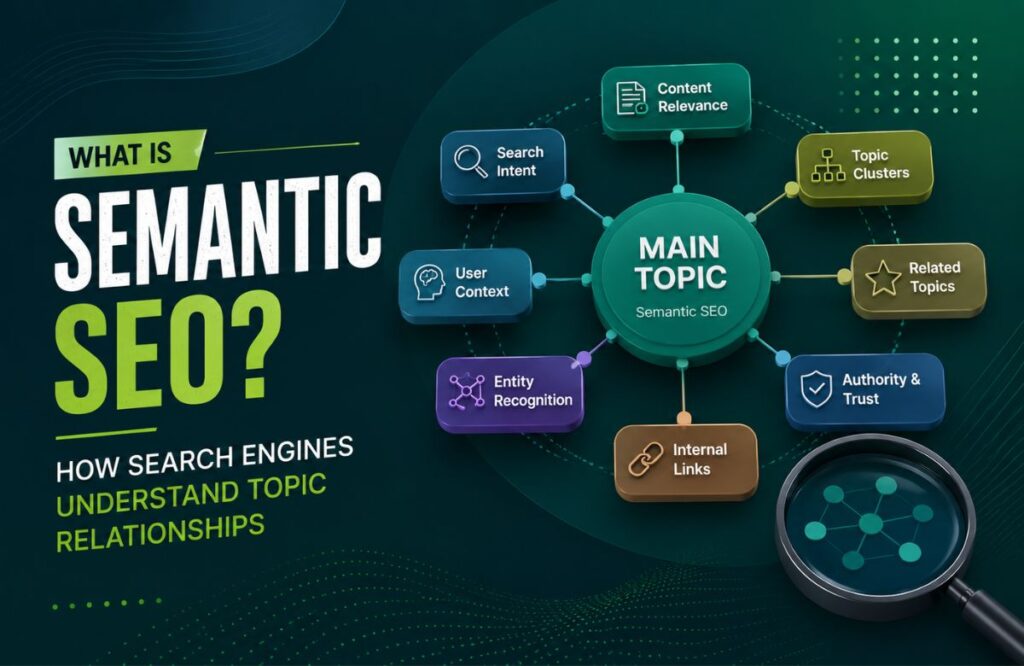
What Is Semantic SEO? Let’s see!! Search engines have become much better at understanding the meaning behind a search query instead of simply matching exact keywords. This is where semantic SEO becomes important.
This SEO focuses on the relationships between words, concepts, entities, and topics. Instead of creating a page around one keyword and repeating it throughout the article, SEO encourages you to create useful content that clearly explains a broader subject.
For example, an article about SEO audits might naturally discuss crawlability, indexing, Core Web Vitals, internal links, canonical tags, and structured data. These related concepts provide additional context about the main topic.
What Is Semantic SEO?
SEO is an approach to search engine optimization that focuses on meaning, context, relationships, and search intent rather than relying mainly on exact-match keywords.
Traditional keyword-focused SEO often asks how many times a keyword should appear on a page. SEO takes a broader approach by asking whether the content thoroughly explains the subject and addresses the user’s needs.
This does not mean keywords are no longer important. Keywords still help search engines and users understand what a page is about. However, they should be used naturally within useful and relevant content.
How Does Semantic Search Work?
Semantic search helps search engines understand the meaning and context behind a query.
For example, someone searching for “apple benefits” may be looking for information about the fruit. Someone searching for “Apple stock price” is likely referring to the technology company.
Search engines can use context and relationships between concepts to determine what a user is trying to find.
Factors that can contribute to understanding a query include:
- Search intent
- Context
- Entities
- Relationships between concepts
- Query wording
- Content relevance
This is why simply inserting a keyword into an article is not enough to create highly relevant content.
What Are Topic Relationships in SEO?
Topic relationships are the connections between concepts that naturally belong to the same subject.
Consider the topic local SEO. Related concepts may include Google Business Profile, local citations, NAP consistency, online reviews, Google Maps, local keywords, and location-based search intent.
These concepts are connected because they explain different parts of local SEO.
When content naturally covers relevant relationships, it can provide stronger topical context than an article that simply repeats the phrase “local SEO.”
Why Are Entities Important for Semantic SEO?
An entity is a distinct person, place, organization, product, or concept that can be identified.
For example, an article about SEO may naturally mention Google Search Console, Google Search, Core Web Vitals, or Google Business Profile when those entities are relevant to the discussion.
Entities can help establish what a page is discussing. However, mentioning as many entities as possible does not automatically improve rankings. They should only be included when they genuinely help explain the topic.
How Search Intent Fits Into This SEO
Search intent is the reason behind a user’s search. Understanding it is an important part of creating semantically relevant content.
Common types of search intent include:
Informational: The user wants to learn something, such as “What is semantic SEO?”
Navigational: The user wants to find a specific website or page.
Commercial investigation: The user is comparing options before making a decision, such as “best SEO tools.”
Transactional: The user is ready to take an action, such as purchasing a product or service.
Content should match the intent behind the search instead of focusing only on the keyword.
How to Create Content Using SEO
1. Start With the Main Topic
Choose one clear primary topic before writing. For example, if your main topic is SEO, determine the major questions users might have about it.
2. Identify Related Concepts
Find concepts that naturally belong to the topic. For SEO, these might include semantic search, search intent, entities, topical relevance, topic clusters, internal linking, and natural language.
Do not force these terms into the content. Use them when they provide useful information.
3. Understand Search Intent
Determine what users expect when they search for your target keyword. An informational query should generally receive educational content rather than a sales-focused page.
4. Cover Important Questions
A comprehensive article can answer questions such as what SEO means, how semantic search works, why topic relationships matter, how entities are used, and how to improve topical relevance.
5. Use Natural Language
Avoid repeating the same keyword excessively. Use natural variations and related concepts where appropriate. Your priority should be clarity and usefulness.
6. Build Relevant Internal Links
Internal links can connect related pages and help users discover additional information.
For example, an SEO website could connect a SEO article with related content about keyword research, search intent, internal linking, structured data, and technical SEO.
Semantic SEO and Topic Clusters
Topic clusters organize related content around a broader subject.
For example, an SEO website could have a main SEO guide supported by articles about technical SEO, local SEO, keyword research, SEO, internal linking, and schema markup.
The supporting pages can link to the main guide and other closely related articles. This creates a logical structure that helps users navigate the website and understand how different topics are connected.
Common Semantic SEO Mistakes
Keyword stuffing: Repeating keywords excessively can make content unnatural.
Adding irrelevant keywords: Do not include unrelated terms simply because they have search volume.
Ignoring search intent: Content can contain many related terms but still fail to answer what the user actually wants.
Creating thin supporting content: Supporting articles should provide genuine value instead of existing only to create internal links.
Writing for algorithms: SEO should improve content quality and context, not make articles sound robotic.
Conclusion
SEO is about helping search engines and users understand the meaning, context, and relationships behind your content.
Instead of focusing exclusively on one keyword, create content that addresses the main topic, related concepts, entities, questions, and search intent naturally.
A strong SEO strategy combines useful content, relevant topic coverage, logical internal linking, clear website structure, and a good understanding of user needs.
The goal is not to include as many related keywords as possible. The goal is to create content that provides enough context for users and search engines to understand the subject clearly.