

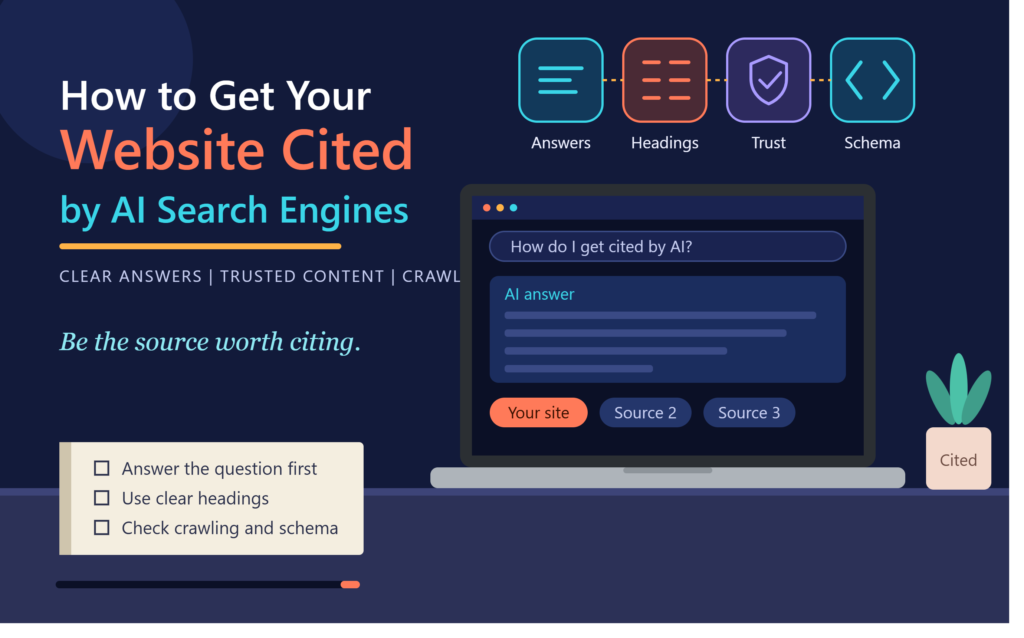
How to Get Your Website Cited by AI Search Engines
Search is changing as people increasingly use AI-powered tools to discover information, compare services, and find answers to their questions. Instead of browsing multiple websites, users may receive a summarized answer with links to selected sources.
For website owners, this creates a new opportunity: making their content useful and understandable enough to be considered for citations in AI-generated answers. Learning how to get cited by AI search engines involves more than adding keywords or installing an SEO plugin. It requires clear information, trustworthy content, accessible pages, and a strong understanding of user intent.
Although no technique guarantees an AI citation, the following practices can help improve your website’s overall search visibility and content quality.
1. Answer Search Questions Directly
AI-powered search tools often need to identify specific information within a webpage. If your content takes too long to reach the main point, users and search systems may find it harder to identify the answer.
Start each important section by addressing the question directly. Then provide supporting explanations, examples, and practical details.
For example, instead of beginning with several paragraphs about website optimization, answer the question first:
What is answer engine optimization?
Answer engine optimization (AEO) is the practice of organizing and improving online content so search systems can understand it and potentially use it to answer users’ questions.
Follow this short explanation with relevant details. This approach makes the content easier to scan without sacrificing depth or usefulness.
2. Organize Content with Clear Headings
A well-organized article helps readers navigate information and understand how different sections relate to one another.
Use one descriptive H1 heading for the main topic, followed by relevant H2 headings and H3 subheadings where needed. Each heading should communicate what the following section covers.
For example, an article about AI search visibility might include sections such as:
- How AI search citations work
- How to structure content for AI answers
- Why website credibility matters
- How to monitor AI search visibility
Use descriptive headings rather than vague labels such as “More Information” or “Additional Tips.” You can also use numbered steps, comparison tables, and bullet points when they genuinely improve clarity.
However, avoid forcing every paragraph into a question-and-answer format. Choose the structure that best explains the subject.
3. Publish Original and Trustworthy Information
Clear writing is important, but useful information also needs credibility. Websites that publish generic summaries without meaningful details may struggle to stand out from competing sources.
Add original explanations, practical examples, expert insights, and evidence that supports important claims. When discussing statistics or technical recommendations, cite reliable sources and explain what the information means.
If you provide a service, describe your actual process and expertise rather than making unsupported claims.
For example, a WordPress development article could explain how canonical tags work, demonstrate a common configuration mistake, and show readers how to identify the problem.
Avoid inventing case studies, customer results, quotations, or personal testing experiences. Trustworthy content should accurately represent what you know and what you have verified.
4. Make Your Website Easy to Crawl and Understand
Even high-quality content can have limited search visibility if search systems cannot access the relevant page.
Review your website’s technical SEO to identify issues that may prevent crawling, indexing, or proper content interpretation.
Check the following areas:
- Robots.txt: Confirm that important content is not unintentionally blocked from crawling.
- Meta robots: Check that pages intended for search visibility are not marked
noindex. - Canonical tags: Use appropriate canonical URLs to identify the preferred version of a page.
- XML sitemap: Include relevant, indexable URLs and keep the sitemap updated.
- Internal links: Connect related pages so visitors and crawlers can discover useful content.
- Page rendering: Ensure important information is available in the rendered page, not only in inaccessible interface elements.
Also review your robots.txt rules for the crawlers associated with the AI search services you want to reach. Different services use different crawlers and access policies, so check their official documentation.
Technical accessibility does not guarantee that a page will be cited, but it can help remove avoidable barriers.
5. Use Structured Data Where Appropriate
Structured data helps search engines interpret specific information about a webpage, organization, article, product, or service.
For example, relevant Schema.org types may include Article, Organization, Person, and BreadcrumbList. Select schema based on the actual content of your page and ensure the markup matches information visible to users.
For WordPress websites, SEO plugins can simplify the implementation of several common schema types. However, review the output rather than assuming that the plugin’s default settings are always correct.
Remember that structured data is not a shortcut to AI citations. Adding schema does not guarantee inclusion in AI-generated answers, and there is no special schema type that guarantees citation by every AI search engine.
6. Strengthen Internal Links and Brand Consistency
Internal links help readers discover related information and provide context about how your pages connect.
For example, an article about AI search optimization could link to a relevant SEO service page or a detailed guide to WordPress website development.
Use descriptive anchor text that explains what the destination page offers. Avoid adding unrelated links simply to increase the number of internal links.
Your brand information should also remain consistent across your website. Use accurate business details, describe your services clearly, and ensure your About page explains who operates the website and what expertise the business provides.
Relevant mentions on reputable third-party websites may also help people and search systems understand your brand. Focus on earning legitimate references through useful resources, partnerships, and genuinely valuable contributions rather than purchasing artificial mentions.
7. Measure AI Search Visibility Without Guessing
Improving your content is only part of the process. You should also evaluate whether your website is gaining visibility and attracting relevant visitors.
Start with Google Search Console to monitor search impressions, clicks, queries, and indexing issues. Use analytics tools to identify referral visits from AI-powered platforms when the available reporting supports it.
You can also manually review relevant questions in selected AI search tools to see whether your website appears as a cited source. Record the query, date, platform, cited URL, and competing sources.
Keep in mind that AI answers can change between queries, users, and sessions. A citation found during one review does not prove consistent visibility, while the absence of referral traffic does not prove that your brand has never appeared in an AI answer.
Track several relevant queries over time and evaluate whether your content improvements are helping users and supporting your broader SEO goals.
Conclusion
Getting your website cited by AI search engines is not about discovering a secret ranking formula. It is about publishing useful information, answering questions clearly, demonstrating credibility, and maintaining a technically accessible website.
Start by improving your most valuable pages. Make their answers easier to identify, support important claims with reliable evidence, strengthen relevant internal links, and resolve technical issues that affect search accessibility.
For WordPress website owners, these steps can support a more sustainable approach to traditional SEO, answer engine optimization (AEO), and generative engine optimization (GEO).
AI citations cannot be guaranteed, but a website that consistently provides clear, accurate, and genuinely useful information is better positioned to serve both its human audience and evolving search experiences.
Explore More..