

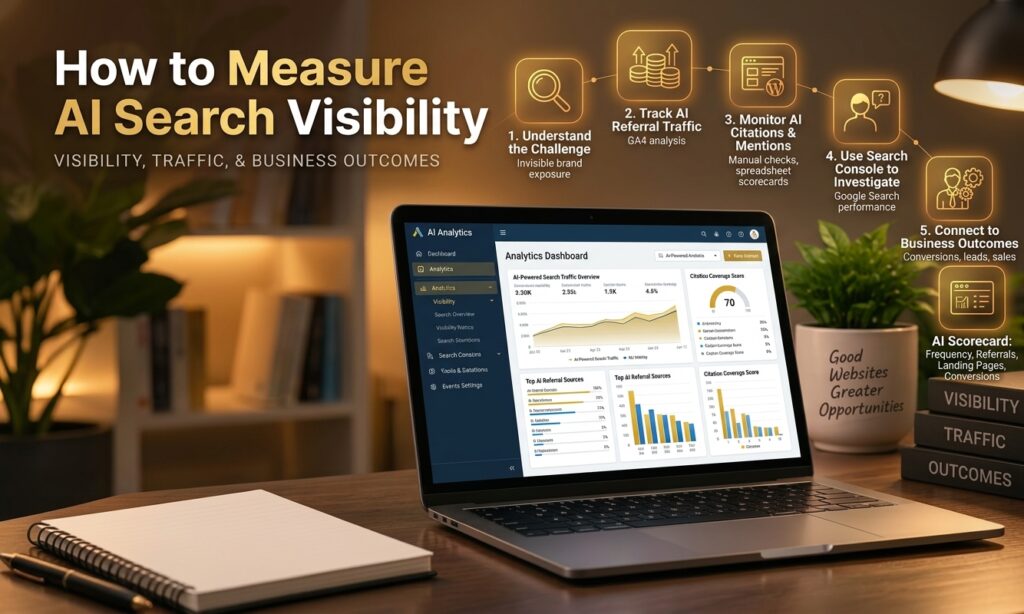
How to Measure AI Search Visibility
Your website may appear in AI-generated answers even when visitors do not click through to your pages. Someone might see your brand mentioned in an AI response, learn about your services, and later visit your website directly. Traditional traffic reports may not reveal every step of that journey.
This creates a measurement challenge for website owners and SEO professionals. How to measure AI search visibility depends on understanding several different signals, including referral traffic, AI citations, brand mentions, organic search performance, and conversions.
Although no single tool provides a complete picture of AI search visibility across every platform, you can build a practical measurement process using existing analytics tools and regular citation checks.
1. Understand What AI Search Visibility Means
AI search visibility describes how often and in what context your website, content, or brand appears in AI-powered search experiences.
This visibility can take different forms. An AI system might cite a specific webpage, mention your brand without linking to it, summarize information from your content, or recommend your business in response to a relevant question.
These outcomes should not be treated as identical.
For example, a website might receive several citations in AI-generated answers but very few referral visits. Another website might receive fewer citations but attract visitors who are more likely to contact the business or purchase a service.
To measure performance properly, separate AI visibility into three areas:
- Visibility: How often your brand or website appears in relevant AI responses.
- Traffic: How many visitors arrive from identifiable AI-powered platforms.
- Business outcomes: Whether those visitors contribute to leads, sales, or other meaningful conversions.
Tracking these areas separately helps you understand whether your visibility is increasing and whether it contributes to your business goals.
2. Track AI Referral Traffic in Google Analytics
One practical way to measure AI search performance is to identify visitors who arrive from AI-powered platforms.
Google Analytics 4 (GA4) can help you analyze referral traffic when the referring platform passes identifiable source information to your website.
Open your GA4 property and navigate to the traffic acquisition report. Review the session source, source/medium, and referral traffic data for visits originating from AI platforms.
Depending on the platform and how the visit is recorded, you may find traffic associated with services such as ChatGPT, Perplexity, or other AI-powered search tools.
To make your analysis more useful, create a consistent reporting process:
- Identify AI-related referral sources in your analytics reports.
- Record the number of sessions and engaged sessions from each source.
- Review which landing pages attract those visitors.
- Compare engagement and conversions across reporting periods.
- Investigate significant changes rather than relying on a single day’s data.
Keep your reporting method consistent. Some AI referrals may appear under referral traffic, while others may be attributed differently or remain unidentified.
Also remember that referral data only measures visits that reach your website and are recorded. It does not measure every time someone sees your brand in an AI-generated answer.
3. Monitor AI Citations and Brand Mentions
Referral traffic cannot tell you how often your content appears in AI answers without generating a click. For that reason, manual citation and brand-mention tracking can provide additional context.
Start by selecting a group of questions relevant to your website, products, services, or expertise.
For example, a WordPress development business might monitor questions such as:
- How do I improve the technical SEO of a WordPress website?
- What should I check before hiring a WordPress developer?
- How can a small business improve its website’s search visibility?
Search these questions in selected AI-powered search tools and record the results.
A simple spreadsheet can include the following columns:
| Tracking field | What to record |
|---|---|
| Date checked | The date of the observation |
| AI platform | The tool where the query was tested |
| Search question | The exact prompt or query |
| Brand mentioned | Whether your brand appeared |
| Website cited | Whether a page from your website was cited |
| Cited URL | The specific page, if available |
| Competitors mentioned | Relevant competing websites or brands |
Repeat the checks periodically using the same questions. You can then identify patterns, discover which pages appear in answers, and find content opportunities.
However, AI responses can vary by query wording, location, personalization, and time. Manual checks provide observations, not a complete record of every AI response. Avoid treating a single successful citation as proof of consistent visibility.
4. Understand the Limitations of Google Search Console
Google Search Console remains useful for evaluating your website’s performance in Google Search. It provides data such as impressions, clicks, click-through rates, average positions, indexing status, and search queries where reporting is available.
However, it should not be treated as a universal AI visibility tracker.
For example, an AI-generated answer may influence a person’s awareness of your brand without producing a click. That interaction may not appear as a measurable visit in your analytics reports.
Google Search Console also does not provide a complete cross-platform report of every time your website is mentioned or cited by AI services.
Use it to investigate related search performance instead.
Look for changes in impressions, clicks, and queries for pages that you have improved. Review whether those pages remain indexable and whether their organic search visibility changes over time.
Where AI-related search features are included in Google’s reporting, review the available documentation to understand exactly what is counted. Do not assume that all AI-generated answers or brand mentions are represented in the same report.
The goal is to combine reliable search data with other visibility signals, not to force one tool to measure everything.
5. Connect AI Visibility to Conversions
Visibility and traffic are useful, but business outcomes often provide stronger evidence of value.
Suppose your website receives visits from an AI-powered platform. Those visitors may read a service page, complete a contact form, request a quote, or make a purchase.
You can investigate these outcomes using your analytics and conversion tracking setup.
Start by defining the actions that matter to your business. For a service website, these might include contact form submissions, consultation requests, or qualified leads. For an online store, purchases and revenue may be more appropriate.
Next, review the conversion performance of identifiable AI referral sessions. Compare their engagement and conversion behavior with other traffic sources, while accounting for differences in traffic volume and user intent.
You should also ask new leads how they discovered your business. A short question on a contact form, or during the initial conversation, can help identify people who first encountered your brand through an AI tool.
Keep attribution limitations in mind. Someone may discover your business in an AI answer, return through a branded Google search, and convert during a later session. Standard analytics attribution may not fully capture that journey.
Therefore, treat AI referrals, assisted conversions, and customer-reported discovery as complementary evidence rather than a perfect attribution system.
6. Create a Simple AI Search Visibility Scorecard
You do not need a complicated dashboard to begin measuring AI search visibility. A spreadsheet is often enough to establish a baseline and monitor changes.
Create a monthly scorecard containing the following metrics:
- AI citation frequency: The number of tracked queries for which your website is cited during the review.
- Brand mention frequency: The number of tracked queries where your brand is mentioned.
- AI referral sessions: Sessions attributed to identifiable AI-related sources.
- Landing pages: The pages receiving AI referral visits or appearing in observed citations.
- Conversions: Leads, sales, or other tracked actions associated with identifiable AI referral traffic.
- Organic search performance: Relevant impressions and clicks from Google Search Console.
For citation and mention tracking, record the number of appearances alongside the total number of queries tested. This gives you a more useful comparison than reporting raw counts alone.
For example, if your website appears in answers for 4 out of 20 tracked queries in one month and 7 out of 20 the following month, your observed citation coverage has increased from 20% to 35%.
This example describes only the queries you tested. It does not represent your website’s total visibility across all AI platforms.
Keep the tracked questions, platforms, and review method as consistent as possible. If you change the test set, document the change so your monthly comparisons remain meaningful.
7. Turn Measurement Findings into SEO Improvements
Measurement is most useful when it leads to specific actions.
If relevant AI answers consistently cite competing websites instead of yours, review the pages those websites provide. Look for gaps in the depth, accuracy, structure, or originality of your own content.
If your website receives citations but very little referral traffic, consider whether the cited content answers the user’s question completely or whether your page offers additional relevant information. Low click volume does not automatically mean the citation has no value.
If AI referral traffic is growing but conversions remain low, investigate landing-page relevance, user intent, page experience, and the clarity of your calls to action.
If neither citations nor referral traffic improve, review your content quality, technical accessibility, internal linking, and the relevance of the queries you are targeting.
Avoid making major changes based on a single observation. Look for repeated patterns and use other available data to validate your conclusions.
Conclusion
Measuring AI search visibility requires more than checking website traffic. Your brand may appear in AI-generated answers without producing a direct click, so analytics alone cannot show the full picture.
Combine AI referral reporting, citation and brand-mention checks, Google Search Console data, and conversion tracking to develop a more balanced understanding of your website’s performance.
Start with a small group of relevant queries, establish a baseline, and review the results regularly. Over time, this process can help you identify which content attracts attention, where your website has visibility gaps, and which SEO improvements deserve priority.
AI search measurement is still evolving, and no single metric captures every interaction. A consistent, evidence-based process will help you make better decisions without confusing brand exposure, website traffic, and business results.
Explore More..