

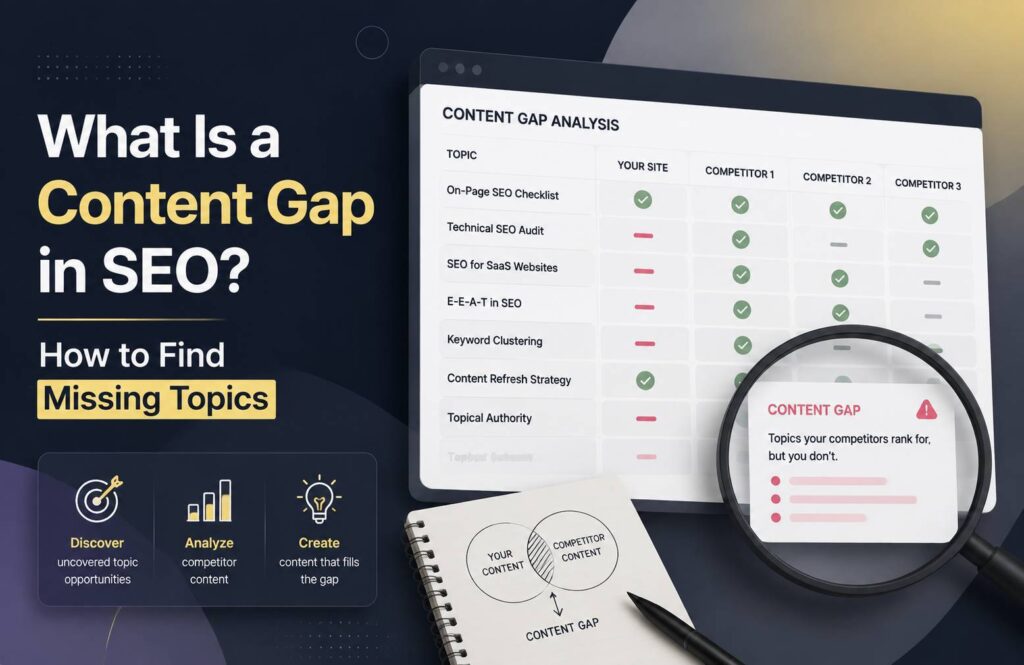
Creating lots of content doesn’t automatically mean a website will rank well. Sometimes, a website has plenty of articles but still misses important topics that users are searching for. This is where a content gap in SEO becomes important.
A content gap is a missing or underdeveloped topic that could help a website better satisfy its audience and compete in search results. Finding these gaps can help you discover new content opportunities, improve topical coverage, and build a stronger SEO strategy.
What Is a Content Gap in SEO?
A content gap in SEO is a topic, question, keyword, or piece of information that your website does not cover adequately but your target audience may be searching for.
For example, imagine a website has several articles about keyword research but doesn’t have content explaining keyword clustering, search intent, or keyword cannibalization.
Those missing subjects could represent content gaps.
A content gap doesn’t always mean that a topic is completely absent. Your website might already mention a subject briefly but lack a dedicated, comprehensive page about it.
Therefore, content gap analysis involves looking for both missing content and opportunities to improve existing content.
Why Does Content Gap Analysis Matter?
Content gap analysis can provide several SEO benefits.
1. It Finds New Content Opportunities
Instead of randomly choosing blog topics, you can identify subjects that are relevant to your audience and connected to your existing content.
This makes your editorial strategy more focused.
2. It Helps Match Search Intent
Users may search for different questions around the same subject.
For example, someone interested in SEO might search:
- What is search intent?
- How does search intent work?
- How do I identify search intent?
- Why is search intent important?
If your website only answers one of these questions, there may be opportunities to address the others.
3. It Strengthens Topical Authority
A website that comprehensively covers related topics can demonstrate stronger topical depth.
Instead of publishing unrelated articles, you can build interconnected content around specific subject areas.
4. It Helps You Compete With Other Websites
Competitor analysis can reveal topics that ranking websites cover but your website doesn’t.
You can then evaluate whether those topics are relevant to your own audience and worth creating.
What Are the Main Types of Content Gaps?
Content gaps can appear in several forms.
Keyword Gaps
A competitor may rank for relevant keywords that your website doesn’t target.
For example, your site may target “SEO audit,” while competitors also rank for “technical SEO audit,” “SEO audit checklist,” and “website SEO audit.”
These additional terms could reveal opportunities.
Topic Gaps
Sometimes the missing opportunity isn’t a single keyword.
Your website may cover graphic design basics but lack content about typography, color theory, or branding.
These broader missing subjects are topic gaps.
Search Intent Gaps
Your website may target a keyword but fail to address the user’s actual purpose.
For example, an article targeting “SEO tools” might only provide definitions when users actually want comparisons and recommendations.
Content Depth Gaps
You may already have an article about a topic, but it could be too short or incomplete.
Adding missing explanations, examples, FAQs, and related information can help make the page more useful.
How to Find a Content Gap Step by Step
You don’t need to guess what your website is missing. A structured content gap analysis can make the process much easier.
Step 1: Choose a Topic or Competitor
Start with a topic you want your website to become known for.
Alternatively, identify a few websites that compete for similar search queries.
Look for competitors with content that is relevant to your target audience rather than simply choosing the biggest websites online.
Step 2: Compare Keywords
Use an SEO tool such as Ahrefs or Semrush to compare your website with competitors.
Look for keywords where competing websites rank but your website doesn’t.
Pay attention to:
- Search intent
- Keyword relevance
- Search volume
- Ranking difficulty
- Existing content
- Business value
Don’t create a page simply because a competitor ranks for a keyword. First determine whether the topic genuinely fits your website.
Step 3: Analyze Competitor Content
Open the pages ranking for your target topics.
Look at what they cover and, more importantly, what they don’t cover well.
Ask questions such as:
- What questions does the article answer?
- What questions are missing?
- Is the content outdated?
- Are there useful examples?
- Does it satisfy search intent?
- Could the topic be explained more clearly?
This process can uncover opportunities that keyword tools alone may not show.
Step 4: Check Google’s Search Results
Search your target keyword manually.
Review:
- Related searches
- People Also Ask questions
- Autocomplete suggestions
- Featured snippets
- Related topics
- Frequently discussed subtopics
These can help you understand what users expect to find.
Step 5: Review Your Existing Content
Before creating a new page, check whether you already have an article covering the subject.
If an existing page covers the topic, consider improving it instead of publishing another article.
This is important because creating multiple pages targeting very similar keywords can potentially lead to keyword cannibalization.
Step 6: Group Related Opportunities
Once you’ve collected potential gaps, organize them into topical groups.
For example, an SEO website might create a cluster around:
SEO Keyword Research
→ Keyword research
→ Search intent
→ Keyword clustering
→ Long-tail keywords
→ Keyword difficulty
→ Competitor keyword analysis
This makes it easier to build a logical content strategy.
Step 7: Prioritize the Best Gaps
Not every content gap deserves an article.
Prioritize opportunities based on:
Relevance + search demand + competition + business value + content quality opportunity
A keyword with high search volume isn’t necessarily the best choice if it has little connection to your website.
Content Gap vs Keyword Gap: What’s the Difference?
The terms are related but aren’t exactly the same.
A keyword gap usually focuses on search queries or keywords that competitors rank for while your website doesn’t.
A content gap is broader. It can include missing keywords, topics, questions, search intents, formats, or information.
For example, your website might technically target the keyword “SEO audit,” but your competitor may have a detailed checklist, examples, templates, and troubleshooting guide.
You may have the keyword covered but still have a content depth gap.
Common Content Gap Analysis Mistakes
Avoid these common mistakes when looking for missing topics.
Copying Competitors
Competitor content should provide ideas, not instructions to copy.
Your goal is to create something more useful and relevant.
Focusing Only on Search Volume
High-volume keywords can be extremely competitive.
A smaller topic with strong relevance and clear intent may deliver better results.
Ignoring Existing Content
Always check your current website before creating a new page.
You may already have an article that can be expanded or updated.
Creating Content Just to Fill a Gap
Not every competitor keyword is valuable.
A topic should make sense for your audience and overall website strategy.
Conclusion
A content gap in SEO represents an opportunity to make your website more complete, useful, and competitive in search results.
The best approach isn’t simply finding keywords your competitors rank for. Instead, look at the bigger picture: topics, questions, search intent, content quality, and what your audience actually needs.
By regularly performing content gap analysis, you can build a more focused content strategy and discover valuable topics before randomly publishing another blog post.