

What Is Crawl Budget?
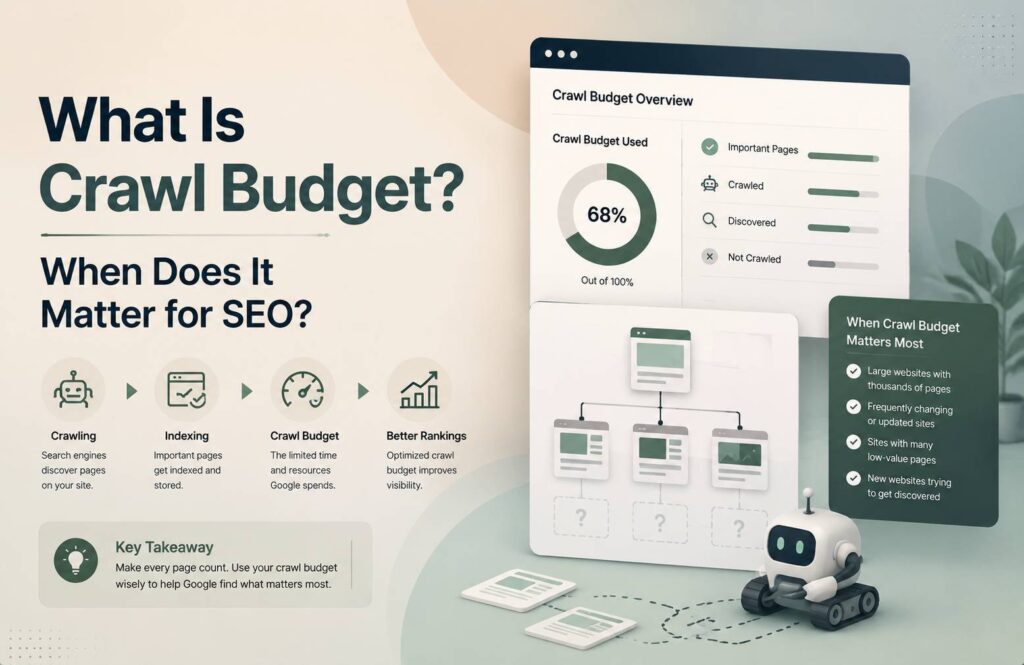
Crawl budget is the amount of crawling resources that a search engine, such as Google, is willing and able to use on a website over a given period. It determines how frequently and how extensively Google’s crawlers visit your pages.
For most small websites, crawl budget is not something you need to worry about. Google can generally crawl and discover pages without special optimization. However, crawl budget can become more important for large, frequently updated, or technically complicated websites.
Understanding how crawling works can help you identify technical SEO problems that prevent search engines from efficiently discovering your important pages.
How Does Website Crawling Work?
Search engines use automated programs called crawlers to discover and revisit web pages. Google’s primary crawler is commonly known as Googlebot.
Googlebot starts with known URLs and follows links to discover additional pages. It can also discover URLs through XML sitemaps and other signals.
After crawling a page, Google may process its content and decide whether the URL should be indexed. This is an important distinction: crawling and indexing are not the same thing.
A page can be crawled without being indexed, and having a large crawl budget does not guarantee that every page will appear in Google search results.
Does Every Website Have a Crawl Budget Problem?
No.
For a small business website or a typical blog with a few hundred pages, crawl budget usually isn’t a major SEO concern. Google can often crawl these websites efficiently without any special action.
Crawl budget becomes more relevant when a website has thousands, hundreds of thousands, or millions of URLs. It can also matter when a website generates large numbers of unnecessary URLs through filters, search pages, parameters, duplicate content, or other technical features.
Therefore, don’t spend time optimizing crawl budget if your website doesn’t have a genuine crawling problem.
When Does Crawl Budget Matter for SEO?
There are several situations where crawl budget deserves attention.
1. Large Websites
Large ecommerce websites, marketplaces, publishers, and platforms can have enormous numbers of URLs. Search engines may need to prioritize which pages to crawl and how frequently to revisit them.
If important pages are buried among thousands of low-value URLs, improving crawl efficiency can become valuable.
2. Frequently Updated Websites
Websites that publish or update content very frequently may benefit from efficient crawling. News websites, large blogs, and ecommerce stores with changing inventory are common examples.
The goal is not simply to make Google crawl more pages. Instead, you want search engines to spend their crawling resources on URLs that are useful and worth revisiting.
3. Faceted Navigation and URL Parameters
Ecommerce websites often allow users to filter products by price, brand, size, color, rating, and other attributes. These filters can generate many URL variations.
If search engines can discover thousands of unnecessary combinations, crawling resources may be spent on URLs that provide little SEO value.
4. Crawl Errors and Technical Problems
Server errors, redirect chains, slow responses, and other technical problems can make crawling less efficient.
Fixing these issues can help search engines access important pages more reliably.
How to Improve Crawl Budget
You don’t need to force Google to crawl your site more often. Instead, focus on helping search engines crawl the right pages efficiently.
Keep Your Site Structure Simple
A clear website structure makes it easier for users and search engines to discover important content.
Use logical categories, descriptive URLs, and internal links that connect related pages. Important content shouldn’t be buried several clicks away from your main navigation.
Create and Maintain an XML Sitemap
An XML sitemap provides search engines with a list of URLs that you consider important.
Keep your sitemap clean and include canonical URLs that you want search engines to discover and potentially index. Remove obsolete, redirected, or irrelevant URLs when appropriate.
Fix Broken Links
Broken internal links can create poor user experiences and waste crawling opportunities.
Regularly check your website for broken links and update them to relevant working pages.
Avoid Redirect Chains
A redirect chain occurs when one URL redirects to another URL, which then redirects somewhere else.
For example:
URL A → URL B → URL C
Whenever possible, simplify this to:
URL A → URL C
This reduces unnecessary steps for both users and crawlers.
Control Duplicate and Low-Value URLs
Large numbers of duplicate or near-duplicate URLs can make a website harder to crawl efficiently.
Review URL parameters, tag pages, internal search results, filter combinations, and other automatically generated URLs. Decide which
pages genuinely deserve to be crawled and potentially indexed.
Improve Server Performance
A website that responds quickly and reliably provides a better crawling experience.
Use reliable hosting, optimize heavy resources, reduce unnecessary server processing, and monitor server errors. Good technical performance also improves the experience for human visitors.
Strengthen Internal Linking
Internal links help search engines discover relationships between pages.
Link important articles and product pages from relevant, authoritative pages within your site. Avoid creating isolated pages that are difficult for crawlers to discover.
Crawl Budget vs. Indexing
One of the most common SEO misunderstandings is assuming that crawling automatically leads to indexing.
They are different processes.
Crawling means a search engine accesses and processes a URL.
Indexing means the search engine decides to store and potentially show that page in search results.
Therefore, if Google crawls a page but doesn’t index it, increasing crawl budget may not solve the problem. You may instead need to examine content quality, duplication, canonicalization, internal linking, or other indexing signals.
How to Monitor Crawl Activity
Website owners can use Google Search Console to monitor crawling and indexing-related information.
For larger websites, server logs can provide even more detailed information about which URLs search engine crawlers are requesting.
Look for patterns such as:
- Important pages rarely being crawled
- Excessive crawling of unnecessary URLs
- Repeated server errors
- Large numbers of redirects
- Parameter-generated URLs
- Slow server responses
These patterns can help identify technical SEO opportunities.
Common Crawl Budget Mistakes
A common mistake is trying to optimize crawl budget on a small website that doesn’t have a crawling problem.
Another mistake is blocking too many URLs without understanding how search engines discover content. Technical directives should be used carefully and consistently.
You should also avoid creating thousands of unnecessary URLs through filters, parameters, internal search pages, or poorly managed site functionality.
Finally, remember that crawl budget optimization isn’t a substitute for creating useful content. Search engines still need strong content, clear site architecture, and appropriate technical signals to understand your website.
Final Thoughts
Crawl budget matters most when a website is large, frequently updated, or generates many URLs. For smaller websites, it usually isn’t a major SEO priority.
The best approach is to make your website easy for search engines to crawl by maintaining a clean site structure, fixing broken links, controlling unnecessary URLs, keeping your XML sitemap accurate, improving server performance, and strengthening internal linking.
Instead of trying to make Google crawl every URL on your website, focus on helping crawlers efficiently discover the pages that matter most.
FAQ
What is crawl budget in SEO?
Crawl budget refers to the amount of crawling resources a search engine allocates to a website. It helps determine how frequently and extensively search engine crawlers visit URLs.
Does crawl budget affect rankings?
Crawl budget does not directly act as a ranking factor. However, crawling problems can indirectly affect SEO if important new or updated pages aren’t discovered efficiently.
Does crawl budget matter for small websites?
Usually not. Small websites generally have fewer URLs and are unlikely to encounter significant crawl budget limitations.
How can I improve crawl budget?
Maintain a clean website structure, fix broken links, reduce unnecessary URLs, avoid redirect chains, maintain an accurate XML sitemap, improve server performance, and strengthen internal linking.
Is crawl budget the same as indexing?
No. Crawling is the process of accessing a URL, while indexing is the process of deciding whether a page should be stored and potentially shown in search results.